Connect With Me

Twitter Button StumbleUpon Button Delicious Button RSS Feed Button

Wednesday, July 4, 2012

Fifteen Minutes of Fiction: “The Hike”

My friend over at The Writing Righter has started a series of weekly freewriting prompts called Fifteen Minutes of Fiction.  If you don’t have time for a full blown scene (like the kind required to write a good flash fiction), freewriting for 15 minutes may be just the option you need.

Instead of working over a story for several days, you have to limit yourself to a mere 15 minutes and write as much as you can in one sitting. If traditional freewriting isn’t your cup of tea, you can cheat a little like I do.  My “freewriting” is a little bit more organized than pure stream of consciousness would be, but it’s what I need to do to get through the allotted time still sane. And if you need a little longer than 15 minutes, no one has to know but you.

This week’s prompt was the starter sentence: “If only she had been looking where she was going, none of this would have happened…”

The Hike

If only she had been looking where she was going, none of this would have happened. Reaching down, she gingerly prodded her now swollen ankle. She didn’t think anything felt broken, but she wasn’t exactly a doctor. All she knew was her ankle hurt far too much to be able to bear her weight, much less get her back up and out of the ravine she’d fallen into. She looked around for a branch thick and long enough to use as a crutch.

After half an hour passed by of painfully scooting herself along the ground on her bottom, she gave up the hunt. In the movies, perfectly proportioned tree limbs always appeared within arm’s reach of a fallen hero. She figured she was in more of a Stephen King kind of story. Sure, chances were she’d live, but all manner of unpleasant things would happen to her before she fought her way to safety.

The ants crawling up her legs were evidence enough of that. Swatting at them, she cursed and scooted away as quickly as she could from the ant hill she hadn’t seen earlier. “Just my luck,” she grunted as she used a tree trunk to pull herself up into a standing position.

“O.k., Jasmine. Time to take stock of what you have.” Swinging her backpack off one shoulder and around, she started rooting through it. “Cell-phone that can’t pick up a signal out here in the middle of nowhere? Check. Almost empty water bottle? Check.”


Photo credit: Bruce Denis

Flash Fiction Friday: “The Transfer”

This week’s Flash Fiction Friday prompt is much simpler than previous prompts. In the style of any genre, the story must start with the sentence “We need to talk about Kevin” and be no more than 1,300 words long.  Also different this week, we’ll be voting for which submission is the best.

I can honestly say I will be surprised if I win the contest. I wanted to do something unexpected with the interpretation of the starter sentence, and I think I have.  While“The Transfer” is a good showing for only a couple hours of writing, I’ve already read some of the other entries and they are amazing. Make sure to check them out, too, and vote (even if you didn’t participate!).

I hope you enjoy this story as much as I did coming up with it!

The Transfer

“We need to talk about KEVIN.” Grabbing his arm, Robert made research coordinator Hanwen Huang stop his advancement down the corridor. “There’s something wrong with this project, and you know it.”

Still with his back to his research assistant, Hanwen grunted noncommittally and shook his arm free. Rubbing his bicep where Robert had grabbed him, he said, “We can talk later. I have to compose a response to the Mars transmission we just received.”

“That’s exactly what I’m talking about! We need to tell them the study volunteers are-“

Fine. The study volunteers are fine, Rob. They transported to the Mars base successfully and they returned successfully. All limbs were intact and accounted for. Their health is unaffected by the transfer and they remain coherent.”

“But what about-,” Robert started, only to be cut off again by Dr. Huang.

“The Kinetic Electron Vehicle Implanted Neurotransmitter project is a success.” Shooting a glare over his shoulder at his assistant, Hanwen whispered harshly, “Don’t you dare mess this up for me, Rob. I’ve worked a long time on this project.”

Robert watched him walk away until he turned at the end of the hallway and disappeared into his dormitory. Dr. Huang was right; the project was a success. Nine months travel time to Mars was inconvenient and problematic. What if an emergency happened to travelers on the shuttle? It was simply not possible to include every type of specialist, both mechanical and medical, on every single flight to and from the planet. Mars had only been made hospitable enough to support human life for a handful of decades. Technological and medical events continued to occur on the Mars base for which the experts stationed there lacked the knowledge and tools to deal with. Radio waves took anywhere from 18 to 30 minutes to send and receive to the planet from Earth, making collaboration with experts on Earth difficult. The wait for needed supplies was another nine months once the laborious conversation finally, if ever, generated a solution.

The KEVIN project was a chance to change that. By implanting a neurotransmitter in the base of subjects’ skulls, the brain would be forced to send signals to all extremities causing electrons to hyper-excite. Those electrons would provide the kinetic energy needed to fuel a transfer of the atomic make-up of the individual via radio waves. Thirty minutes later, give or take depending on the position of the two planets, a copy of the subject was created atom by atom at a holding cell set up with the raw materials needed while the original body remained in stasis on Earth. The project had so far successfully transferred two dozen volunteers to and from the Mars base.

The research team should have been celebrating a victory. And they were, except for one member.

“I know I’m ‘just’ a research assistant,” mumbled Rob as he placed his forefinger in the biometric scanner, “but I have eyes! You’d have to be blind not to see what’s happening to these people.” After several beeps, the door to the lab opened and Rob went to his work station. Switching on the two monitors, he watched the video feeds of subjects in their rooms under post-transfer observation.

All twenty four subjects were confined to their quarters. The first set of twelve traveled last week and the second set traveled just that morning. Robert’s attention was focused on the first twelve video feeds. So intent was he on the feeds, he didn’t realize he’d been leaning in closer until his nose bumped up against the monitor.

Pulling back, he grabbed a tissue to wipe off the smudge he left on the screen. As he was wiping, his eye caught a flash of movement in one of the rooms. Instantly he dropped the tissue, but all subjects remained seated on the edge of their beds, staring at the wall, the way they had been for the past seven days.

“I saw it. I know I did. It’s going to happen again, I just have to keep watching.” Rob rubbed his eyes and sighed. He adjusted the positioning of the camcorder he’s set up on a tripod on his desk. Leveling it so that both monitors full of video feeds could be seen through its lens, he hit the record button and went to pour himself his fifth cup of coffee for the afternoon.

He knew what he saw, even if the video feeds didn’t corroborate it. There was something wrong with the recordings or someone was altering them post-capture. If he saw it on the monitors in the live feeds, he could capture it on a camcorder not wired into the system. He had to.

“Damnit! We’re out of creamer.” Grumbling, Rob left the lab to restock the coffee supplies. The doors shut behind him as he walked out, cutting him off from the video feeds. Not that Rob was looking at them, his mind focused on obtaining the creamer needed to make the laboratory coffee palatable enough to drink.

If he had been looking at the feeds, he would have seen the first twelve subjects standing in the center of their rooms, staring at each other through the walls.


Photo credit: Onkel_Wart

Monday, June 25, 2012

Marketing Ploys: Do You Really Know What Those Words Mean?

neon sign reading words

The teacher in me loves commercials. They make wonderful teaching material, not just because they illustrate rhetorical topics like ethos and pathos, but because they require savvy viewers to think.

Thinking is a skill that takes practice and advertisements offer plenty of chances to flex your brain. Every commercial you watch on t.v. or hear on the radio is another chance to flex your critical thinking skills and analyze how you're being marketed to. Educated people should never be duped by the tactics advertisements use to try and make a sale.

The following video isn't one of the commercials I've used in my lessons in the past, but you can bet it will be making an appearance in the future. It explains what the terms you think you recognize in the dairy aisle of your grocery store really mean. Linguistically, I like this video because it points out the ambiguity of language and the power that words can have. Educationally, this video is a good endorsement of why critical thinking skills are important outside of the classroom.

For the squeamish among you, this video does not contain any graphic images; there is a shot of a chicken without a beak in the beginning, but it passes quickly and no animal is mutilated during the video. Yes, in addition to educating people about marketing terms, this video has an agenda. I have no problem with its promotion of local, independent farms (just be aware that were this video an essay, it would not only be categorized as "informative" but also "persuasive").


Source: in.gredients.com

Photo credit: Pierre Metivier

Sunday, June 3, 2012

How to Find Main Points for Your Essay

Picture of dots on a street

Several weeks ago, a distraught student left this comment on my blog post “How to Write an Essay FAST”:

How are you meant to come up with the 3 main points? Like, that makes no sense; I can't just pull them out of thin air! How is it meant to be done?! And if no one can tell me (which it seems every teacher just says I need to think about the text more), then it can not be something that can be graded! Sorry for the rant - super confused and effed for my essay!

Unfortunately, I don’t think this blog post came out in time to help that student write his/her essay, but hopefully other people struggling with the same issue will be able to benefit from this post in time for their deadlines.

If you too struggle with coming up with main points for your projects, you are NOT alone.  This is the most frequent issue students will come to me for help with.  Once they know what to write, they can generally handle the question of how to write their essay effectively on their own.   Even professionals face this issue! They’ll be given the topic of their presentation, but they have to come up with the main points themselves.

While I can come up with main points for my students, I dislike doing so.  They  will need to find a way to come up with them on your own so they can function on their own, when I’m not there to help.  Luckily for them (and you!), I’ve developed a series of questions that makes finding main points much easier.

I will present the questions first. It may seem English-oriented, but it will work for all subject areas.  See the examples that follow where I  use it for English, history, and science topics to learn how to apply it to different subjects.

Note that these topics reflect the broad ones normally found in high school and early undergraduate classes. Higher-level undergraduate and graduate classes assign much more content-specific essay topics that pull from the material discussed in class. Usually these higher-level prompts include several questions you must answer as you write your paper, and so guide you in that way towards your finished product.

English: Cyberbullying
History: Michael Jackson
Science: Stem cell research

The Questions

Who are the CHARACTERS
What is the SETTING?
What is the PLOT?


Using just these questions will guarantee you three main points, the standard for most high-school essays. If you're in a college preparatory high-school or in college, you may need more, depending on the length of your project. If that's your case, don't worry; in the following examples, I'll show how you can get several main points from one question.


Who are the CHARACTERS?

While the word “characters” calls to mind literature in many people, it can be applied to non-literary people, places, and things.  The character of an essay is whoever (or whatever) will be the main focus of the paper. You can include points about other “characters” as well, of course, but only if they are connected closely to the main character of your essay AND don’t stray from the essay’s thesis statement.

If you’re still confused about what exactly a “character” in an essay is, the following examples should help you understand the idea more clearly. 

English: Cyberbullying

The main “character” would be cyberbullying, the act.  You definitely need to devote at least a paragraph towards defining and describing the act for readers.  Even if most people are familiar with the term nowadays, defining it and including relevant examples clearly tells readers what YOU mean when you use the term.  If your page limit gives you the room, other characters include the bully and the victim. The terms may seem self-explanatory, but these terms  actually become controversial when the Internet is involved. Google legal cases involving cyberbullying to find out just how much explanation these characters need.

History: Michael Jackson

Obviously, the main character of this essay would be Michael Jackson.  A thorough essay will take the time to describe who this man was for readers who aren’t familiar with the details. If your essay’s thesis statement focuses on Michael’s personal life, additional characters that can be elaborated on are his father, Michael Joseph Jackson, and his now ex-wife, Lisa Marie Presley.  However, if your essay deals with the people and events who shaped him into the man he ultimately became, Lisa Marie Presley would NOT be a main point because their 8 year relationship (4 years married and 4 years divorced) took place when he was already an adult. 

Science: Stem cell research

The character for this topic would be stem cell research.  However, that term includes many subtopics that need to be defined.  A more complete list of “characters” would be adult cells, cord cells, and embryonic cells. The type of research also needs to be described. The controversy surrounding this type of research could also be counted as characters (those for stem cell research and those opposed to it), but I will be labeling those as plot elements.

What is the SETTING?

The “setting” of a topic includes not only its physical location, but also its historical context and closely related ideas.

English: Cyberbullying

In the case of cyberbullying, the setting is the Internet. Depending on your thesis statement, you could be writing about how the intangibility of the World Wide Web has created a society in which people can be bullied even within the confines of their home.  If you are looking at the legal angle of cyberbullying, then you could tackle the issue of responsibility (i.e., does the physical location of the computer used to make the attacks determine responsibility).

History: Michael Jackson

The topic of Michael Jackson could cover a number of different settings.  His physical locations, for example (i.e., his birthplace, the schools he attended, the many residences he has called home, and his travels), could be considered a setting, as could the era in which he grew up and lived (i.e., the state of the music industry when he first entered it and how it changed, the evolution of media from vinyl, to compact disc, to mp3). Depending on how biographical your essay is, I would include his contemporaries in this category as well.

Science: Stem cell research

There are quite a few different settings for stem cell research. You could approach the topic by identifying the physical location of research (i.e., where the laboratories are located that pursue this type of research, the equipment and media used in the laboratories for research).  The historical context of stem cell research is also an important setting as an understanding of this research requires knowledge of what technologies were available in the past and are currently at our disposal.

What Is the PLOT?

Traditionally, the plot is a literary term that describes the series of events that make up a story and how they relate to each other.  I like to think of a topic’s plot as what has happened in the past concerning the topic, what is currently happening, and what may happen.  The plot is NOT historical context, however.  Historical context is more descriptive and passive whereas the plot of a topic is active and definitive.  Hopefully the following examples will explain what “plot” is and isn’t better than I have here.

English: Cyberbullying

In the case of cyberbullying, the plot would include the first recorded instance of bullying via the Internet.  It would also include any legal cases that have set legal precedent and case law regarding online bullying.  Most importantly, the plot is made up of the conversation surrounding the topic. Are there contrasting viewpoints over important issues pertinent to this topic? What about proposed laws or practices that have not yet been enacted? If you can figure out what people are arguing over, then you’ll find the meat of this main point.

History: Michael Jackson

Seeing what makes up the plot for an essay on Michael Jackson is a little easier because there are so many significant events that drive this celebrity’s “story.” If you have not yet discussed his childhood as part of the characters or setting points, you can certainly include it under this point. Likewise, his marriage and the birth of his children could have been included under characters or the plot point.  The allegations made against him, his creation of Neverland Ranch, his fame, and ultimately, his death, all fall under this category. The slant you will put on your paper all depends on what your thesis statement says.

Science: Stem cell research

Stem cell research may not be a celebrity like Michael Jackson, but it too had a childhood.  Important milestones in this research would be featured in the plot point, as well as the controversy surrounding it.  Those who are for this research and those who are against it will need to be included here (or at least their views, in the absence of well-known proponents or opponents).  Alternative research paths that show the same promise of stem cell research could be introduced here as well.

****

As you are coming up with the main points of your essay, keep in mind the prompt you were assigned and your thesis statement.  Using the three questions I introduced in this blog post, you could come up with many main points, but they’ll be worthless if they are irrelevant to the aim of your paper.

My technique is certainly not foolproof, but it’s what I use to help students generate main points for essays. Hopefully you’ll find it of use, too!

Photo credit: Peter Kaminski

Wednesday, May 30, 2012

Flash Fiction Friday: “Into the Dungeons”

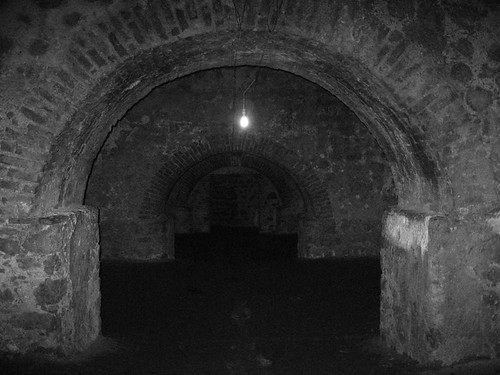
photo of a dungeon

The prompt for this week’s Flash Fiction Friday piece calls for my favorite type of story – a horror story! In particular, the prompt calls for the fear of the unknown.  Since I have a story I’m working on that includes a big, horrible monster that is never quite revealed until the end, I chose to continue the adventures of Lizbeth and Katta as they seek it out.

With work keeping me busy lately, time got away from me and I wasn’t able to complete the scene.  I’m posting what little of it I was able to finish in the hopes that it will entertain those of you who have expressed interest in what happens next in the story.

Prompt: This week write a story about perceived fear, either triggered or based on a phobia, and to make it fun use the following word list: Dark, Crunching, Eerie, Monster and Fear.
Genre: Open
Word limit: 1313
Deadline: Thursday, May 31 @ 9:00 a.m. EST

Into the Dungeons

Darkness dripped from the ceiling, a black sludge that smothered the walls. Katta's candles seemed to burn more quickly in the dungeons and it wasn't long before Lizbeth was handing her a fresh one to replace the stub. The girls' shadows looked pale against their surroundings.

“I told you it wasn't a stain.” Lizbeth's voice sounded shrill as it echoed down the passage that still lay in front of them. The cloaked forest creature had told them of the existence of a monster far more terrifying than the Cauchemars, and where to find it.

“I knew there was something odd about that black area in the tapestries. I just never thought it would be... I hope we're doing the right thing coming down here.”

Katta muttered “Whatever” and dropped the candle stub into her left pocket, startling the sleeping Shadowkin within. With an annoyed chirp, Chicky poked his head out of the pocket, then immediately ducked back inside.

“What's wrong with Chicky?” asked Lizbeth.

“I think he's hiding.” After making sure Chicky was safely tucked away, Katta started chuckling.

“What's so funny?” asked Lizbeth.

“I guess the cloaked freak in the forest was telling the truth after all.”

“Why is that so funny?”

Katta stopped chuckling and stared at Lizbeth through the struggling candle-light. “You're serious, aren't you?” Letting out a whistle, she said, “Oh boy, we really messed up when we chose you.”

Her rising irritation distracting her from her fear, Lizbeth rounded on Katta, hands on her hips. “Instead of laughing at me, you could try explaining it to me instead, you know.”

Katta stopped chuckling to stare back at the peevish girl standing before her. The smile lingering on the corner of her mouth grew wider and she coughed to hide it, pretending to fuss over the candle as it sputtered in her breath.

“Well?”

“The Shadow People don't just help you for nothing. Altruism isn't in their nature. They're sadistic and evil. Their first instinct is to deceive and destroy. If they sent us down here, then they either think they can benefit from it or that it will end us. Knowing them, probably both.”

Katta stopped talking a moment to let her words sink in. She continued to walk down the passage, trusting Lizbeth to follow. “Nothing good can ever come of dealing with the Shadow People. But it's the only choice we have left.”

“You really hate them, don't you?” Lizbeth panted, trotting beside Katta to keep up with her longer strides.

“You think? I've watched them as they corrupted and killed children. I saw them literally tear a girl apart and consume her. They treat their own kind hardly better.”

“What about Chicky?”

“What about him?” Katta snapped. “He's different. He's nothing like the other Shadow People.” She cupped the pocket where he hid protectively and stalked off angrily.

“I didn't mean to imply... I'm sorry,” Lizbeth called after apologetically. Then, more loudly, “Where are you going?”

“Where do you think I'm going?” Katta snapped again.

“It's just...we've been that way.”

“What are you talking about?”

“When we first came down here, we turned left at the first intersection. After that, we took another left and then the passage curved to the left again. If you go that way, you'll be going back towards the first left we took.”

“You mean I'll be going in a circle?” Katta asked, her irritation with Lizbeth abating while her frustration with the endless passageways increased.

When Lizbeth nodded, Katta cursed and hurled the candle she held into the darkness. Lizbeth gasped and started after it, “We need that!”

The flame was smothered by the darkness as soon as it left Katta's hand, the candle making a soft thud as it landed and rolled away somewhere in the blackness that now enveloped the girls.

In the silence, the girls heard a low rumble.

“What was that?” Lizbeth squeaked.

“I don't know, but Chicky's not happy about it.”

Frightened chirps were coming from the pocket the Shadowkin hid within and Katta placed one hand inside to comfort him.

“I don't feel good about this either,” Lizbeth said as the rumble grew into the unmistakable sound of a growl. “Light another candle, Katta, quickly, before something hap-”

Dirt and dust fell onto the girls and into their eyes as the growl grew, shaking the walls around them. Lizbeth clapped her hands over her ears and started to scream.

Photo credit: Naeema Campbell

Sunday, May 27, 2012

New Template and Comment System

Photo of blue acrylic paint glob

After putting it off for months, I have finally gotten around to over-hauling the website’s template and comment system.  There were little issues here and there that needed addressing in the template and Blogger’s built-in comment system wasn’t as versatile as readers wanted (not to mention it wouldn’t let me reply to individual comments).

I loved the old green template, but I think I’ve found one that, after I made a few modifications to the code, is equally clean and simple. Blue is my favorite color anyway, so the new look has quickly grown on me. I’m still tweaking fonts and sizes, so if there is anything on the page that is difficult for you to read or that you think could look better, let me know via e-mail or by leaving a comment in the new comment system.

The chief complaint I heard about the Blogger comment system was the need for a Google account to post a comment. I decided to use Disqus because it gives readers the choice of leaving a comment anonymously as a “guest” or through their  Disqus, Google, Open ID, Twitter, or Yahoo accounts.   It even lets me import all my Blogger comments so I don’t lose any valuable feedback!

Let me know what you think!


Photo credit: Photo Bunny

Friday, May 11, 2012

Why Grammar Check Leaves Much to Be Desired

Dear John

The “Dear John” letter pictured above has been used for decades to illustrate the importance of punctuation.  Running each version of it through Microsoft Word reveals no errors and no mention of the existence of the other version. While spelling is fairly straight forward to check, grammar is much more ambiguous.  Depending on the context, the removal or addition of a comma can alter the entire meaning of a sentence with it still remaining grammatically correct.  This letter is a clear example of that!

Errors Grammar Check Cannot Find

Dr. Daniel Kies from the College of DuPage has researched the topic extensively for ten years.  By running text that contains 20 common usage errors through grammar checkers, he has documented how well they work. His findings aren’t pretty.  Not only did grammar checkers catch less than half of the 20 errors, they often offered the wrong advice for correcting the error.  He describes the results of his research and their importance much more eloquently than I could paraphrase it; please, please, please read it here on his web page.

One of the many grammar errors that grammar checkers cannot detect is the inappropriate use of an essential or non-essential clause. A single comma is all that differentiates the two.  This and other syntactical choices that are based on semantics will always give grammar checkers problems.

Computers cannot think and therefore cannot intuit meaning from words.  This limitation is why it is essential that you or someone you trust proofreads your work.  Do NOT rely on your word processor to catch grammar errors for you.

More Evidence on the Issue

With how easy it is for spell checking programs to make errors, it baffles me that anyone would put their trust in a program that attempts to check the correctness of grammar, a much more complex process.